Unpaid Business Invoices? Find the Right Collection Agency.
Connect with independent commercial collection agencies that specialize in recovering unpaid business invoices. Tell us about your receivables, compare potential partners, and choose the agency that fits your needs.
Find a Collection Agency Compare Collection Options
- Free review of your submission; matching is free to you
- Most agencies work on contingency: paid only from what they recover[source]
- A collection agency for small business debts, local or national
- You approve the agency and its written terms before anything happens
SmallBizDebtCollection.com is an independent referral platform. We do not collect debts or provide legal services. Participating collection agencies may pay us a referral fee.
Prefer email? Write to info@smallbizdebtcollection.com.
What is small business debt collection?
A collection agency for small business accounts is one way to handle it. Small business debt collection is the process of recovering money that customers owe your business. Usually that means unpaid invoices for goods delivered or work completed. For most owners, it starts in-house with reminders, phone calls and a firm letter.
When those stop working, the account moves to a third party. That might be a collection agency that specializes in business debts, or a law firm that represents creditors. The goal stays the same at every stage: collect as much as you can, as fast as you can, without creating new legal or reputational problems.
Collecting from a business is different from collecting from a consumer. The main federal consumer collection law is the Fair Debt Collection Practices Act. It covers obligations “primarily for personal, family, or household purposes”[source], so a business-to-business invoice generally falls outside it. That doesn’t mean anything goes. State licensing rules, contract terms, and defamation and harassment laws still apply. That’s one reason experience matters when you choose who will contact your customer.
We’re a matchmaker, not a collector. Any business owner, from a one-person shop to a growing company, can use the form to find a small business debt collection option that fits. The “Which option fits you?” section below explains each one.
Which option fits you?
There are three main ways to get a business debt collected. None is best for every invoice. The right one depends on the amount, the age of the debt, whether the customer still talks to you, and how much control you want.

1. AI-powered or automated collection
Software sends scheduled reminders, payment links and follow-ups, sometimes with AI-written messages or voice agents.
- Fits
- many smaller, newer past-due invoices where the customer is still reachable.
- Pros
- fast to start, consistent, usually lower cost, keeps a lighter tone.
- Cons
- limited against customers who ignore you or dispute the debt; no skip tracing or legal leverage on its own.

2. Collection attorney or law firm
A lawyer sends demand letters on firm letterhead and, if you authorize it, files suit and enforces a judgment.
- Fits
- larger balances, personal guarantees, clear refusals to pay, or debts already in dispute.
- Pros
- legal leverage, can sue and enforce, gives legal advice.
- Cons
- court costs and fees can be higher, and litigation takes time.

3. Regular collection agency (local or national)
A third-party agency contacts your customer, locates debtors who went quiet and negotiates payment, usually on contingency.
- Fits
- silent or slow-paying customers and aging invoices you want handled.
- Pros
- no recovery, usually no fee; professional process; attorney networks for suits. A local agency may know your area’s courts and businesses; a national one may cover debtors in many states.
- Cons
- contingency rates rise with age and difficulty.
ACA International describes itself as “The Association of Credit and Collection Professionals.” Founded in 1939, it brings together third-party collection agencies, law firms, asset buying companies, creditors and vendor affiliates. It also sets ethical standards for its members[source].
RMAI (Receivables Management Association International) runs the Receivables Management Certification Program, launched in 2013. The program certifies debt buyers, collection agencies, collection law firms, brokers and vendors. Certification is required for RMAI’s debt-buying members and voluntary for collection agencies and law firms[source]. Many certified businesses are debt buyers. We don’t buy debt, and we don’t match on RMAI certification.
Partner standards
These three industry groups set standards for commercial collectors. If a partner says it belongs to one, verify it with the group itself before you sign.
- International Association of Commercial Collectors (IACC). An association for commercial collection professionals. Its stated mission is to deliver education and professional resources to members. It describes itself as a resource for professionals who “deliver high-quality, ethical and compliant collection services”[source].
- Commercial Law League of America (CLLA) and CLLA certification. CLLA is a not-for-profit association of creditors’ rights attorneys, bankruptcy attorneys, commercial collection agencies and legal network personnel[source]. Its commercial collection agency certification program dates to 1975 and is endorsed by IACC. Certified agencies must pass an annual independent CPA audit, keep separate trust accounts verified annually, carry a surety bond, meet education requirements and accept independent ethics oversight[source].
- ACA International. “The Association of Credit and Collection Professionals,” founded in 1939, whose members include third-party collection agencies, law firms, creditors and vendors, and which establishes ethical standards for its members[source].
How getting matched works
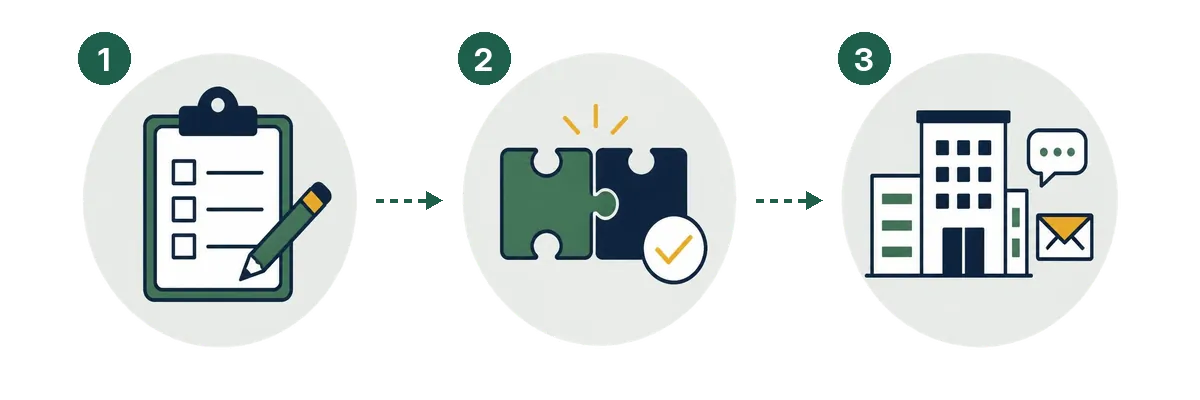
Tell Us About Your Debt
Use the short form: your business’s state, the debtor’s state, roughly how much is owed and how old it is. It takes about a minute.
Get Matched
We check that it’s a business debt in a state we serve, then introduce potential independent collection agencies based on industry, location, debt size and requirements.
Choose Your Agency
Review your options and their written terms, then contract directly with the agency you choose. Nothing is placed without your agreement.
Free review of your submission. No cost to be matched. About 60 seconds.
Get matched freeWhy use a collection agency for small business debts?
- A repeatable process
- Tools to find debtors who went quiet
- Attorneys in the debtor’s state
Chasing a late payer takes time you could spend running your business. It can also strain a relationship you’d rather keep. A collection agency for small business accounts brings three things most owners don’t have in-house:
- A repeatable process, so no account slips through the cracks.
- Tools such as skip tracing and business credit research, for finding debtors who have moved or gone quiet.
- Access to collection attorneys in the debtor’s state, if a lawsuit becomes necessary.
The U.S. Chamber of Commerce notes that agencies use databases to locate nonpaying customers, contact them by written notice and phone, and report back on settlements and payments[source].
A third party also changes the tone. A customer who ignored your fifth email often responds when a professional collector calls. The call shows you’re serious and organized. A professional collector should apply that pressure without crossing legal lines. They also know how to set up a payment plan when a customer truly can’t pay in full.
When to stop chasing and get help
There’s no single right day, but there are clear signals. Business News Daily reports that most companies send past-due accounts to a collection agency at 90 to 120 days. It adds that waiting longer makes recovery much less likely[source]. Consider escalating sooner if you see any of these:
- The customer has stopped answering calls and emails
- Promised payment dates keep slipping, or a payment plan was broken
- Checks bounce or card payments fail
- The customer suddenly disputes work they previously accepted
- You hear about layoffs, closures, a sale of the business or a change of ownership
- The time you spend chasing is worth more than a contingency fee
Before you escalate, send a written demand. It often settles the matter. Our free past-due invoice demand letter template gives you wording you can adapt. Our full guide on how to collect unpaid invoices from a business walks through every stage, from the first reminder to a lawsuit.
What does a debt collection agency for small business cost?
Most collection agencies work on contingency. They keep a percentage of what they actually recover, and you owe nothing if they recover nothing. Published ranges vary by source. As of 2024, Business News Daily says contingency fees typically range from 20% to 50%, depending on the size and age of the debt[source]. The U.S. Chamber of Commerce gives a range of 25% to 50%, with higher rates for older or harder accounts[source]. Some agencies also offer flat-fee “pre-collection” letter services for newer accounts[source].
Legal action is usually priced separately. If an account goes to an attorney, expect court costs and possibly a different contingency rate. Ask every partner for these terms in writing. Then compare what you’d actually net, not just the headline rate. For example, a 30% fee on $10,000 collected leaves you $7,000.
Our unpaid invoice “worth after fees” calculator lets you plug in the rate you’re quoted. Our page on collection agency fees for small business explains what drives the number.
Which route fits your unpaid invoice?
| Situation | Usually the best next step |
|---|---|
| Newly late, customer still responsive | Reminder, phone call, then a written demand letter |
| Small balance, debtor identifiable, you have time | Possibly small claims court, if your state’s limit and rules fit |
| Customer silent, debt aging, you want it handled | A collection agency on contingency (how to hire one) |
| Larger balance, personal guarantee, or a clear refusal to pay | A creditor-rights attorney, often through an agency’s attorney network |
| Contractor or supplier on a construction project | Consider lien rights first: see mechanics lien vs. collection agency |
These are typical patterns, not fixed routing rules. Dollar amounts and days past due mentioned on this site are general guidance; each claim is matched on its own facts.
Outsourcing collections for small and growing businesses
Thinking about handing unpaid invoices to a professional firm? Start with our guide to outsourcing collections. Then decide whether to outsource accounts receivable or only overdue invoices, and compare a collection agency vs attorney vs AI.
Getting ready yourself? Use the free collection toolkit with past due invoice email templates. Quick answers: how a collection agency works, when to send an invoice to collections, questions to ask a collection agency, contingency vs flat fee, what an agency needs from you and success rates and timing.
Industries we match
- Construction
- Trucking and freight
- Medical and dental
- Wholesale
- Manufacturing
- Staffing
- Agencies
- Professional services
We focus on small businesses that invoice other businesses. That includes construction contractors and subcontractors, trucking and freight carriers, and medical and dental practices collecting from other businesses. It also includes wholesalers, manufacturers, staffing firms, agencies and professional services firms. They all run into the same problem: work delivered, invoice unpaid.
Each industry has its own documents, payment customs and leverage points. A partner who knows them makes a difference. See the industries page for specifics, or our state guide for customers in New York.
Choosing a collection agency for small business: what to ask
Whether or not you use our matching service, ask any agency these questions before you sign:
- What is the contingency rate for an account like mine, and does it change with age, size or legal action?
- Are there any upfront, setup, or minimum fees?
- Are you licensed and bonded where the law requires, including the debtor’s state?
- How will you contact my customer, and how do you protect my reputation?
- How and how often will you report progress?
- How are collected funds held and how fast are they sent to me?
- What happens if I want to withdraw the account?
- Who are your attorneys in the debtor’s state, and what does suit cost?
Business News Daily also suggests checking the Better Business Bureau, asking for references, and confirming errors-and-omissions insurance[source]. Our sister site, Collection Placement, has state-by-state collection guides and a matching form, free for creditors, for business debts.
What we are, and what we’re not
- We are a matching service. We review claims and introduce you to independent collection partners.
- We are not a collection agency. We never contact your debtor.
- We are not a law firm. Nothing on this site is legal advice.
- We are not a debt buyer. We never purchase receivables. You keep ownership of your claim.
Any partner is a collection agency we introduce you to. Before you sign with any partner, check their licensing, credentials and terms yourself, using the questions above.
Free review of your submission. No cost to be matched. About 60 seconds.
Get matched freeHow we’re paid
Matching is free to you. Collection agencies we introduce pay us a referral fee. You don't pay us anything. Your partner’s fees are set in your written agreement with them. Read the full How we’re paid disclosure.
Not the right fit?
If you’re a bank, credit union or lender with charged-off consumer accounts, this service isn’t built for you. Our sister site Sell Charge-Offs works with lenders on charged-off portfolios. If your debtor is an individual consumer rather than a business, consumer collection rules apply. Speak with a licensed consumer collection agency or attorney instead.
What is business-to-business debt collection?
It is collecting money one business owes another, usually unpaid invoices for goods or services. Federal consumer collection law covers debts for personal, family or household purposes[source], so these debts are governed mainly by contracts and state law.
Do collection agencies buy debt instead of collecting it?
Most collection agencies collect on your behalf for a fee; you keep ownership. Debt buyers are different businesses that purchase accounts. We don’t buy debts. See collection agency vs debt buyer.
Can a collection agency sue my customer, or only a lawyer?
A lawsuit is generally filed by an attorney on your behalf; agencies usually forward accounts to attorneys when suit makes sense[source]. Suit costs should be agreed in writing first.
What is a CLLA-certified agency?
An agency certified under the Commercial Law League of America’s program, which requires an annual independent CPA audit, verified trust accounts, a surety bond and ethics oversight[source].
What is ACA International and does membership matter?
ACA International is an association of credit and collection professionals founded in 1939 that sets ethical standards for members[source]. Membership signals commitment to industry standards but isn’t a guarantee of results.
What is IACC and why does membership matter?
The International Association of Commercial Collectors serves commercial collection professionals; its guidelines say it requires members to be bonded[source]. Verify membership in its directory before you sign.
Frequently asked questions
Are you a collection agency?
No. We are a matching service, free to you. We review your claim and connect you with an independent collection agency. We don’t refer you to attorneys or provide legal services. The partner you choose does the collecting under its own written agreement with you.
Do you buy debt?
No. We never purchase debts. You keep ownership of your receivable, and any money collected flows under the terms you agree with your chosen partner.
How much does a small business debt collection agency charge?
Most agencies work on contingency and keep a percentage of what they recover. Published ranges run from about 20% to 50% (Business News Daily, as of 2024) and 25% to 50% (U.S. Chamber of Commerce CO—), with older or harder accounts usually at the higher end. Always get the rate in writing.
What does it cost to use your matching service?
Nothing. Matching is free to you. Collection agencies we introduce pay us a referral fee. You don't pay us anything. Our How we’re paid page explains this in plain language.
When should I send an unpaid invoice to a collection agency?
When reminders, calls and a written demand haven’t worked, or the customer has gone silent. Business News Daily reports that most companies place accounts at 90 to 120 days past due, and that odds of recovery fall the longer a debt sits.
Can you help with consumer debts?
No. This service is for money owed to your business by another business or, in some cases, a government entity. Lenders with charged-off consumer portfolios should look at our sister site, Sell Charge-Offs.
Will a collection partner sue my customer?
Only if you authorize it. Many agencies forward accounts to a collection attorney when a lawsuit makes sense, and that usually carries extra costs that should be spelled out in your agreement before anything is filed.
What information do I need to get matched?
Your contact details, your business’s state, the debtor’s state, the amount owed, how long it has been past due, and whether the debtor is a business. Don’t send the debtor’s name, account numbers or your files through the form; the agency you choose asks for those after you’re introduced.
Owed money by another business?
Tell us about the unpaid invoice. If a participating collection agency says it takes claims like yours, we’ll introduce you. Matching is free to you.
Get matched with a collection partner